- +34 961 201 963
- blanquer@blanquer.com

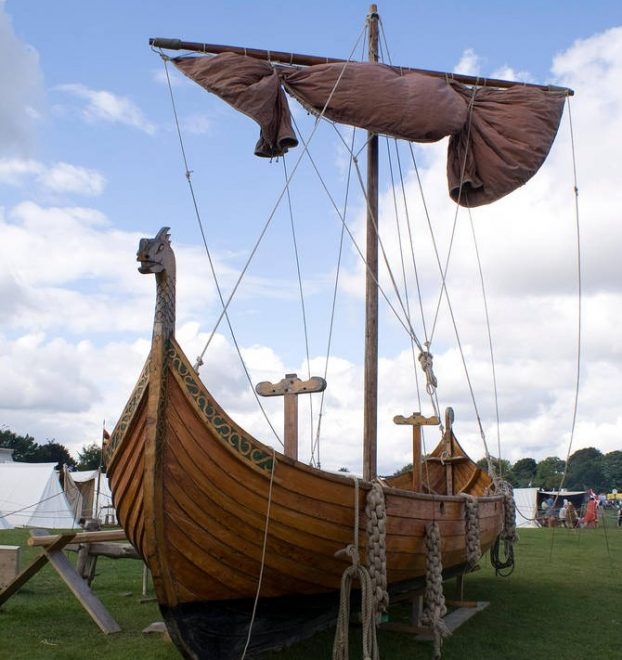
Viking ships had a flat keel (lower part where the whole frame rests), for navigation in shallow draught areas. The hull was built with lashed wooden planks. They had a removable mast and a square sail, as well as space for the oars. They used a side rudder on the starboard side and a large stone with a hole in the center (where a rope was tied) as an anchor.
Almost all ships were built without using frames, overlapping wooden planks, so it was necessary to cover the joints between the planks. Therefore, the joints were waterproofed with moss or wool impregnated with tar. A recent study suggests that they used tar to waterproof the ships.
The technique used for the construction of the ships is called “tingladillo” construction, which means that the planking of the ship is built on the basis of courses. The hull of the ships was built on a solid keel made with a straight trunk that, together with the stem (extension of the keel at the front) and the stern (structural element that ends the boat at the stern), made up the backbone of the hull. To this structure, the planks were adapted and fastened with iron nails, a kind of hull sheathing that gave the boat agility and resistance. In addition, they increased the strength by reinforcing the boat with transverse beams at the height of the waterline. Finally, sturdy timbers propped up the mast.
CHOICE OF WOOD.
Small boats were built by one man, but large boats were built by a crew of workers under the command of a chief builder, who was responsible for choosing the right wood. The laborers felled trees, shaped the logs and moved the wood, among other activities. Skilled laborers worked on the keel, the bow and stern, etc. etc.
The Vikings had different types of ships, specifically designed to operate in the most efficient way the tasks for which they were conceived. For exploration missions, they needed smaller and extremely portable ships; for trade, they used ships large enough to store cargo; and for raids, ships had to be light, fast and easy to maneuver.
The species used were oak wood, valued as a hardwood that withstood the ocean waters. But since it was not easy to obtain, they also used ash, elm, pine, birch, alder, linden and others. However, the keel continued to be made of oak, because in addition to being the backbone of the ship, it was also the part that rubbed the most when dragging it over land.