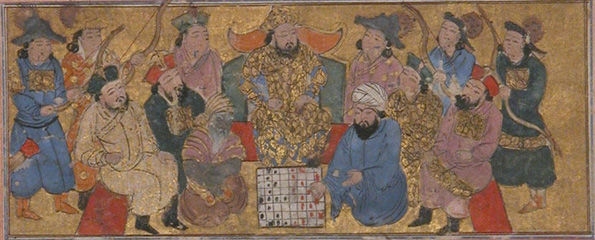
With more than 1500 years of history, its origins date back to the 6th century in India. Known as Chaturanga (the army game), it spread to Persia through the trade routes and later to Asia. It was not until after the Muslim conquest of Spain, approximately during the 8th and 10th centuries, that the game made the leap to Europe.
During the Middle Ages, Spain and Italy were the countries where this game was most practiced. The Spanish priest Ruy Lopez de Segura (16th century), who taught Philip II to play and who was considered one of the first great chess players in Europe after defeating the best Italian players, was one of the first analysts to write a treatise describing the rules that are still used today.
Since its entry into Europe, chess underwent different evolutions both in its form and in its rules. The most remarkable of them was the introduction of the figure of the queen, which marked the biggest difference between Arabic and modern chess.
The materials and their designs have been evolving with the times, allowing to have travel versions or even digital boards, although chess players usually prefer the wooden ones for their stability, proportionate weight, warmth during the game and great quality.
The range of woods used for the manufacture of chessboards and chess pieces is very wide. From inexpensive woods such as pine to much more exotic woods for luxury chessboards. For the lighter tone pieces, woods such as boxwood, beech, birch, maple and erable are usually used. While for darker pieces the shades are more varied, from the blackness of ebony or wenge, through walnut and rosewood, to reddish shades such as Redwood (African Padouk).
PHOTO1: Detail from “Buzurgmihr Masters the Game of Chess”, Leaf from a Shahnama (Book of Kings), ca. 1300-30. Abu’l Qasim Firdausi (935-1020). Iran or Iraq. Photo by: The Metropolitan Museum of Art, New York